We present to your attention, dear anonymous, a completely cheap, “anti-crisis” Wi-Fi antenna “Tincan+” made from a can of food, which can be found in any nearby store. This is fish, coffee or any other product, packed in a can with an internal diameter of 83 mm (3.27 inches). This antenna is the younger sister of the more well-known Wi-Fi “gun”. In comparison with the “gun”, it has 3 dB less gain, but is much cheaper and easier to make yourself and has better repeatability. If you add a cheap USB Wi-Fi adapter to it, then with this kit you can “cheaply” connect your old Athlon or Core2 Duo to high-speed Internet, for which buying a new PCI Wi-Fi card looks like an unnecessary luxury.
To make the antenna, you will need the following materials:
- The tin can, of course, already empty;
- A piece of tin to make a round patch. You can use the lid from the same can;
- Bolt and nut M3;
- A tube with an external diameter of 6 mm, which is used as a spacer. Can be made from the same tin;
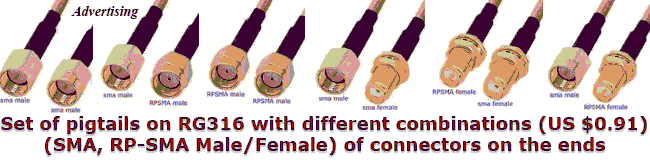
- Pigtail or a piece of thin coaxial cable;
Antenna input impedance 50 Ohm, estimated gain 8.5 dB. Schematic imagery of the antenna: Antenna appearance:
 The can should be cut to a height of 8 mm. The round patch is made of 0.2-0.3 mm thick tin. The central core of the pigtail is soldered to the patch, the braid to the can (from the inside). It is desirable to keep the braid up to 3-5 mm above the bottom of the can. To protect against atmospheric influences, the can is closed from above with a polyethylene lid, ordinary lids from glass jars will do. The characteristics of the “Tincan+” antenna were calculated in the HFSS simulator (taking into account the effect of the polyethylene lid). The main characteristics of the antenna are shown in the graphs:


 As you can see, the antenna requires a minimum of costs and materials to make. You can even do without a pigtail and SMA connectors by soldering the cable directly to the USB Wi-Fi “whistle”. For soldering, it is better to use a thin RG178 or RG316 cable with solid Teflon internal insulation, which does not melt during soldering. The adapter should be placed near the antenna, connected to the computer with a long USB cable (up to 5 m).
Related links:
- Antenna prototype on the Lan23.ru forum;