


 The Moxon rectangle (also called Moxon antenna) is a compact, two-element directive antenna derived from the VK2ABQ square, developed by Les Moxon (G6XN). It's popular among amateur radio operators for its simplicity, low profile, and good performance. The Moxon rectangle consists of two parallel dipole elements bent into a rectangular shape with coupled tips facing each other:
- Driven element — the fed half, forming the top two sides of the rectangle
- Reflector element — the parasitic half, forming the bottom two sides
- Both elements have their ends folded toward each other, leaving a small gap in the center
The shape looks like two "C" or "U" shapes facing each other, forming an almost-closed rectangle.
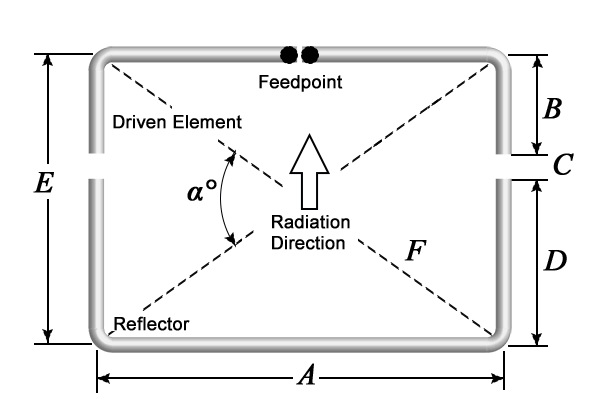
Schematic image of the antenna:
JavaScript source code: Copyright ©2026- 3G-Aerial
Limitations and features of antenna calculations
Key Dimensions
The antenna is usually described by five dimensions (often designated A–E), but for convenience we have added a few more parameters:
- A — length of the driven element's horizontal section and reflector horizontal section;
- B — length of the driven element's folded-back tails (toward center);
- C — the gap between the tips of the two elements;
- D — length of the reflector's folded-back tails;
- E = B + C + D — the total length of the rectangle vertical side;
- F —diagonal of the rectangle (size for spreaders);
- DE = A + 2B — total wire length of the driven element;
- R = A + 2D — total wire length of the reflector;
Dimensions calculation are based on Cebik (W4RNL) formulas with MoxGen-style empirical corrections. No NEC optimization is performed! You can export a standard NEC model file for loading into EZNEC, xnec2c, etc. You can also export the model in a custom 4NEC2 format that includes variables, or in an MMANA model file. Dimensions can be further optimized using these programs.
 |
 |
 |
| VSWR< | Impedance | Radiation pattern |
 |
 |
 |
| Gain | S11 | Front/back ratio |
Related links:
- "Designing Moxon Rectangles by Equation and by Model", L. B. Cebik, W4RNL;
- "MoxGen—Moxon Rectangle Generator", Windows program for calculating Moxon antenna — Dan Maguire, AC6LA;


The site has comments on social networks, which have much more opportunities for communication.