


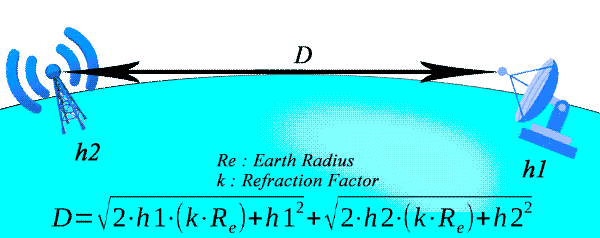
Optical (geometric) line of sight is limited by the visible horizon and is calculated using the Pythagorean theorem with the full formula shown in the figure. This is the formula used in the calculator. In the formula, h1 and h2 are the antenna heights, Re = 6,371,302 m is the mean Earth radius, and k is a correction factor that accounts for the radio horizon. Due to the effect of tropospheric refraction, radio waves propagate beyond the visible horizon — the radio ray bends downward toward the Earth's surface, following its curvature. To simplify calculations, the concept of the "effective Earth radius" is introduced: the radio wave is assumed to travel in a straight line, but the Earth's radius is treated as larger than it actually is. As a result, the radio horizon extends approximately 15% farther than the visible horizon. Under standard atmospheric conditions, k = 4/3 is commonly used, meaning the effective Earth radius is 1/3 larger than the actual one. When calculating optical line of sight, k is obviously equal to one. The degree of tropospheric refraction is frequency-independent up to millimeter-wave frequencies. Simplified formulas are more commonly encountered in practice:
 These formulas are derived from the full expression by neglecting the second term — the square of the antenna height — which is much smaller than the first term.
It should be kept in mind that in addition to tropospheric refraction, other factors can extend the radio propagation range. These include ionospheric reflection, diffraction around obstacles (including at the horizon line), and scattering of radio waves on tropospheric inhomogeneities. It is also necessary to account for any shielding obstacles along the path. The best approach is to consult a coverage map published by most network operators, which takes terrain into account. One example is this online service for calculating radio link feasibility over complex terrain.
It is important to understand that line of sight is a necessary but not sufficient condition for reliable radio communication at high frequencies (Wi-Fi and 4G). Any shielding obstacles along the path must also be considered — the Fresnel zone calculator can help with this — as well as antenna gain and equipment transmit power, for which the radio link budget calculator will be useful. Our calculator also includes an option to estimate the communication range taking into account 60% Fresnel zone clearance when the zone is partially blocked by the horizon.
Related links:


The site has comments on social networks, which have much more opportunities for communication.