


 Despite the development of electromagnetic simulators, the developer sometimes needs to have at hand a simple calculator that allows one to pre-determine the parameters of the microstrip line. For example, the Microwave Office package already includes such a calculator. There are several methods for calculating the parameters of a microstrip T-line that differ in complexity, calculation accuracy, and the allowable range of input parameters. For this reason, different programs and calculators may give different results. Our calculator is based on Hammerstad and Jensen's calculation method of the microstrip T-line, which has a quite high calculation accuracy.
There are enough similar calculators on the web, many of which calculate incorrectly even using the same formulas. To verify and evaluate the error of this calculator, the quasi-static characteristic impedance was calculated for a number of microstrip lines using the ANSYS 2D EXTRACTOR electromagnetic simulator. The calculation results are presented as the tabular data: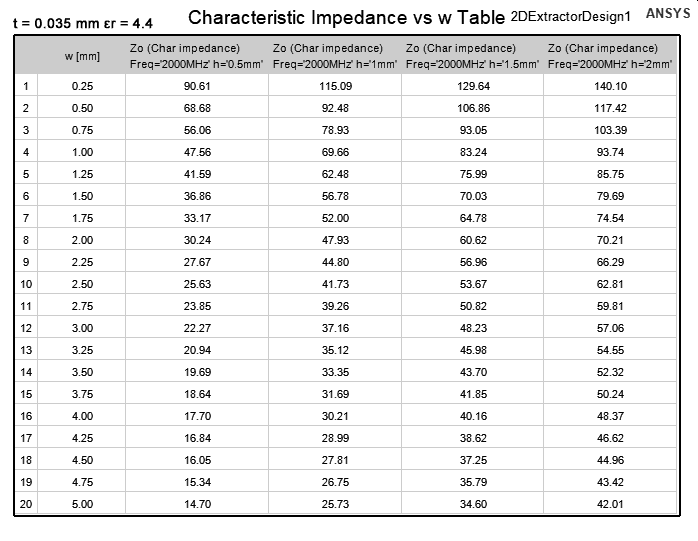
JavaScript source code:
Copyright ©2025 - 3G-Aerial
The calculator is based on ©1994-2003 Daniel R. McMahill source codes.
Limitations and features of antenna calculations
The calculation of a microstrip line with losses and taking into account the end effect according to the method described below is implemented in our Android application “Characteristic impedance”, that you can download by clicking or scanning the QR code below. In the application, the reverse calculation is also available, finding the width and length of the strip according to the given characteristic impedance and the electrical length of the T-line.
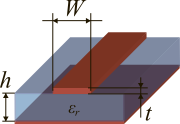
The calculator allows you to make an approximate calculation of the characteristic impedance of a microstrip transmission line, provided that the line operates at a frequency below the critical one. In this calculator, the quasi-static characteristic impedance without taking into account the frequency dispersion is calculated using the formulas of Hammerstad and Jensen:
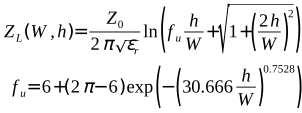
The formula gives an error of no more than 0.03% for W/h < 1000.
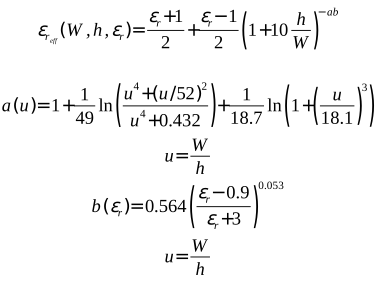
The quasi-static value of the effective permittivity for a microstrip line is calculated using the following equations:
The correction for the stripe thickness, as well as the rest of the line parameters, are calculated by the formulas of the same authors, except for the characteristic impedance of the T-line, taking into account the frequency dispersion, which is calculated using the Jansen and Kirschning formulas. More details about all calculation methods with formulas and references to the literature in the article at the first link below. Formulas were used (numbering in the article) 11.4-11.6, 11.15-11.18, 11.22-11.50, 11.65-11.68. The total error in calculating the parameters of a microstrip line, taking into account the frequency dispersion, does not exceed 1%. The prototype of this calculator is at the second related link below.
Literature:
- E. Hammerstad and R. H. Jensen, "Accurate Models for Microstrip Computer-Aided Design", Symposium on Microwave Theory and Techniques, 1980.
- M. Kirschning and R. H. Jansen, "Accurate Model for Effective Dielectric Constant of Microstrip with Validity up to Millimeter-Wave Frequencies", Electronics Letters, 1982.
- R. H. Jansen and M. Kirschning, "Arguments and an accurate Model for the Power-Current Formulation of Microstrip Characteristic Impedance", Archiv für Elektronik und Übertragungstechnik (AEÜ), 1983.
Related links:
- The electrical parameters of microstrip lines (Sourceforge)
- Microstrip Analysis/Synthesis Calculator (Copyright © 1994-2003, 2010 Daniel R. McMahill)


The site has comments on social networks, which have much more opportunities for communication.