


 As is known, the length of a half-wave linear dipole is equal to half the wavelength in free space, taking into account the multiplying shortening factor. The shortening factor K, in turn, depends on the ratio of the wavelength to the dipole diameter. This dependence is usually given in the form of a “graph from Antenna Book”. This graph starts from the research of Schelkunoff S. A. and Friis H. T. (see literature references below the article).

The thing is, an infinitely thin half-wave dipole with infinite conductivity has a length exactly equal to one half-wavelength and a feed point impedance of 73.129 Ω. This is an ideal antenna that does not exist in practice. A real dipole has a finite thickness, and must be shortened to achieve resonance. Its feed point impedance decreases accordingly. However, the shortening factor depends not only on the ratio of wavelength to dipole diameter, but also on many other factors. In particular, on shortwave bands a long dipole is suspended at its ends by support ropes. This adds end capacitance, requiring the dipole to be shortened even further to maintain resonance. In the graph, curve A represents a dipole in free space, while curve B accounts for end capacitance. The boom, mast, mounting hardware, and nearby conductive objects also have an effect. At HF and VHF, ground proximity has a significant influence on feed point impedance. For these reasons, the results produced by this calculator should be treated as approximations only. The missing data points at λ/d=20 and λ/d=30 in the graph were computed using the HFSS simulator. The interpolation through these points is shown as a dashed line. Our calculator uses the mathematical framework underlying these graphs. All calculations are performed for a dipole in free space. Further details are provided below.
JavaScript source code: Copyright ©2017- 3G-Aerial
Limitations and features of antenna calculations
A folded dipole is effectively "thicker" than a linear dipole made from tubing or wire of the same diameter, and must therefore be shorter. This can be accounted for by calculating an equivalent "virtual" diameter for the folded dipole, which is then used to determine the shortening factor from the graph.
where:
- deq - equivalent diameter for the folded dipole;
- d - wire diameter;
- s - center-to-center spacing between the dipole wires
(in our diagram s = H + d);
The calculator on this page uses the general impedance formulas for a linear dipole under the assumption of a sinusoidal current distribution along its length. The script finds the dipole length at half-wave resonance, i.e. when X = 0, and then determines R for that length. The feed point impedance of a half-wave dipole equals its radiation resistance, assuming infinite wire conductivity. As the dipole is shortened, this resistance decreases and is always less than the theoretical value of 73 Ω.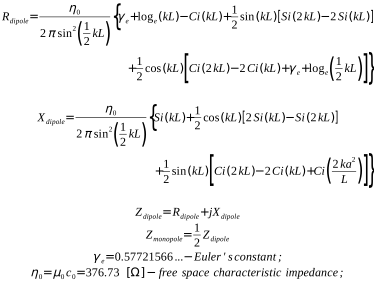 Where k = 2π/λ is the wavenumber; L is the physical length of the dipole; a is the dipole radius (half of diameter d); Ci(), Si() are the trigonometric integral functions. The impedance of a folded dipole can be calculated by representing it as a superposition of a two-wire transmission line and two parallel radiating elements. We will not go further into the theory here. Those interested can follow the links below.
A calculation similar to this calculator is available in the Android application: Dipole Antenna Calculator, available on Google Play. You can download it to your mobile device by clicking on the QR code or scanning it. Don't forget to rate the application…
The calculator calculates the dimensions of an alone dipole and is completely unsuitable for calculating the dipole dimensions of a multi-element antenna. The Yagi-Uda DL6WU antenna calculator calculates the dimensions of a dipole, taking into account the influence of passive elements and the boom. Given NEC kernel limitations, the shortening factor at VHF and above frequencies may not always be calculated correctly by EZNEC, 4NEC2 etc. The dipole can be calculated more accurately at these frequencies in ANSYS HFSS by adding its mounting elements to the model.
Formulas and calculation method:
- C. A. Balanis, Antenna Theory: Analysis and Design (3rd ed. 2005), John Wiley & Sons, Inc., (Ch. 4, pp. 151-218; Ch. 8, pp. 433-494);
- Hum, S. V. Folded Dipole — lecture notes, ECE422, University of Toronto. waves.utoronto.ca
- Abramowitz, M. & Stegun, I. A. Handbook of Mathematical Functions, NBS, 1964. §5.2 (Si, Ci rational approximations). Archive.org
Literature:
- Antennas: theory and practice. by: Schelkunoff S. A. & Friis H. T., Publication date: 1952. Publisher: New York, Wiley, (pp. 450, Ch. 13.24, Fig. 13.33);
- Feed-point impedance - ARRL Antenna Book (21st Edition, Chapter 2-5, Fig 8);
Useful links:
- Detailed calculation of dipole feedpoint impedance: Wikipedia;
- Dipole antenna calculator - TRANSLATORCAFE, another similar calculator using the approximation of graph above;


I am a bit puzzled though... first thing, why doesn't the calculator accept small wire diameters (for example at 27MHz the minimum is 22mm (!!)). Second, where does the impedance (which is significantly lower than 72ohms) come from? Do you assume the presence of a ground?
Thank you!