


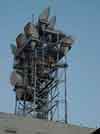
 The horn antenna belongs to the class of so-called aperture antennas. Aperture is the effective opening area of the antenna. Such antennas, unlike wire ones, “catch the wave” directly with their opening, and the horn antenna is a vivid example of this. It's like a blue whale catching plankton. The more he opens his mouth (aperture), the more plankton (electromagnetic energy) he will catch. In other words, the gain of a horn antenna is directly proportional to the aperture area of the horn, and we can get impressive gain simply by increasing its size. Horn antennas are widely used in professional radio relay communications or as dish feeds.
 By making a simple DIY horn antenna without special phase-aligning tricks like an H-shaped horn, we can get gain of up to 20-25 dBi. The advantages of a horn antenna include the fact that it is sufficiently broadband and, therefore, has good repeatability, and has a fairly simple design with a relatively high gain. Of the minuses, one can mention a large consumption of material in comparison, for example, with a panel patch antenna having the same gain, as well as a large windage. Many do-it-yourselfers are scared by the use of horn antennas as measuring standards in professional technology. How can we even dream about the horn antenna with our tin cans! Well, is it comme il faut to use a tin can as an antenna instead of a segment of a professional round waveguide? But it works! For most anonymous people, getting foil fiberglass, and even more so copper plates or something like that, is quite problematic and expensive. Therefore, the use of tin sheets for the making of a do-it-yourself horn antenna is not only acceptable, but also economically justified. Moreover, you can use plywood or carton in combination with metal foil. You can see one of these designs at the link at the end of the article.

Horn antennas are divided into the following categories:
- conical;
- sectoral;
- pyramidal;
- corrugated;
 The pyramidal horn antennas are best suited for DIY. You can calculate the structural dimensions of such an antenna using our online calculator. The electromagnetic energy collected by the horn enters a segment of a rectangular waveguide. Inside the waveguide there is a waveguide-to-coaxial transition, approximately the same as that of a can antenna. By changing the size and position of the exciting probe, it is possible to match the antenna in a wide range with both 75-ohm and 50-ohm feeders.
In the making of a horn, it is desirable to use stiffening ribs along its outer side. Such ribs can be made from a corner, from the same tin, etc. After all, a do-it-yourselfer who lives in a summer cottage or in a village house often has to become a tinsmith, maintaining the house in good condition. Therefore, many people know their secrets in this matter, which they can share here in the comments. The main rule in this case is that the inner surface of the horn and waveguide remains smooth, without protrusions.
Related links:
- Horn antenna on wikipedia;
- Low cost horn antennas for 23 cm band - design by Thomas Henderson, WD5AGO [PDF];


The site has comments on social networks, which have much more opportunities for communication.