


Custom Google Search
Articles
- Details
- Hits: 8092
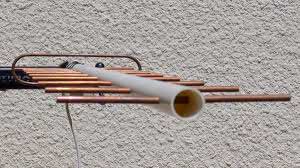 A few years back, video blogger KREOSAN generated massive hype around his "Wi-Fi gun." Many people concluded that all it took was a marker, pliers, and scissors to slap together any microwave antenna without much effort or understanding. They'd then post it on their video blog, hoping it might go viral and turn a profit. What's worse, even failed attempts riddled with glaring technical errors get uploaded to video hosting platforms, leading inexperienced viewers to draw similarly flawed conclusions. In this article, we'll break down these mistakes using one of the most popular antennas as an example: the Yagi-Uda. We'll examine a design for the 2400 MHz Wi-Fi band and analyze how seemingly minor assembly details—ones that appear insignificant at first glance—can cause the antenna to perform abysmally or fail completely.
- Details
- Hits: 7849
 Quickly developing 4G networks require new frequency resources and have long appeared on UHF, from 5th to 20th LTE bands, depending on the region. This requires the development of simple and efficient antennas for these bands. In addition, the presence of MIMO has already become the standard for 4G networks and the manufacture of a SISO antenna for the fourth generation network is completely irrelevant at the moment. To support this technology, we need two antennas. However, if we use a symmetrical patch, then we can combine these two antennas in one, thereby significantly saving on “iron”. This, along with other advantages of the patch -antennas, have determined the choice of this design…
- Details
- Hits: 1740
 We present to your attention, dear anonymous, a completely cheap, “anti-crisis” Wi-Fi antenna “Tincan+” made from a can of food, which can be found in any nearby store. This is fish, coffee or any other product, packed in a can with an internal diameter of 83 mm (3.27 inches). This antenna is the younger sister of the more well-known Wi-Fi “gun”. In comparison with the “gun”, it has 3 dB less gain, but is much cheaper and easier to make yourself and has better repeatability. If you add a cheap USB Wi-Fi adapter to it, then with this kit you can “cheaply” connect your old Athlon or Core2 Duo to high-speed Internet, for which buying a new PCI Wi-Fi card looks like an unnecessary luxury.
- Details
- Hits: 20815
 Today I and you, dear anonymous, will deal with heavy weapons, namely various Wi-Fi/3G/4G gun-antennas. This “gun antenna,” otherwise known as the Disk-Yagi, got publicity to DIY-ers thanks to a video blogger under the nickname KREOSAN. The video was presented in the manner typical of this video blog as a kind of super-creative. At the same time, this video blogger is not an antenna technician. Therefore, many have the following questions. Can you believe in the reliability of all this? What are the differences between regular and disc Yagi-Uda antennas? Why make a more complex design? Let's start looking for answers to these questions…
- Details
- Hits: 6860
 How to make an effective long-range Wi-Fi antenna with your own hands? Let's see in our calculator what the range of Wi-Fi depends on. We can see that most of the parameters are determined by the properties of our equipment, which we cannot change. But the greater the gain of the antenna, which we can make ourselves, the greater the distance range. Which antenna has the highest gain and what other criteria should you use to choose an antenna design? More details under the cut…
- Details
- Hits: 12591
 Most of the popular antennas presented on our website, such as the BiQuad or Quados antenna, have one significant flaw—not a wide enough bandwidth. It is quite enough only for the Wi-Fi band, but in 3G/4G networks with a common DIY-er who does not have special tuning devices, these antennas will most likely work very badly. In addition, with the rapid development of mobile Internet networks, with the allocation of more and more new bands for this, there is a desire to make an universal broadband antenna for all occasions, and not to constantly remake them or use a set of several antennas and get on yourself nerves constantly switching them back and forth. Is it possible? The improved or expanded Batwing antenna brought to your attention, the authorship of which belongs to the user with the nickname com666 (he is also the author of the “Flex” antenna), is able to satisfy this cherished desire of yours, dear anonymous…
- Details
- Hits: 12025
 The "Double ellipse-rectangle" brought to your attention is one of the few professional designs that can be safely recommended for DIY makers who don't have special devices for tuning antennas. The antenna is a modification of the “elliptical patch” known in the professional community. Why patches are especially popular at the microwave frequencies and why the elliptical patch is good, we have analyzed in sufficient detail in the Ellipse Patch 2x2 antenna article, so we will not repeat it. However, often a radio amateur is stopped by the need to cut a proper ellipse out of metal sheet. Try to make a proper circle, not to speak of an ellipse! The design presented here, while keeping all the advantages of the “Ellipse Patch”, allows you to make it “rectangular” without cutting crooked lines.
Advertising on the website

Download our Cantennator app for antenna calculation from GooglePlay
Scan QR-code, if you are here on desktop, or tap it, if you are here on phone:


Follow the site news on Twitter.
Scan QR-code, if you are here on desktop, or tap it, if you are here on phone:

Read more …